Meditation, sleep and stress relief with natural stones. A calm Dunes & Dreams guide, plus a simple two-stone practice you can try tonight.
Read the full article
Finding Your Way Back to Calm
Meditation, Sleep, Stress and the Gentle Power of Natural Stones
Dunes & Dreams | Health & Wellness
Have you ever climbed into bed feeling physically exhausted, only to discover that your mind has decided it’s the perfect time to start thinking about absolutely everything?
The conversations you had. The things you forgot to do. Tomorrow’s responsibilities. The worries you can’t quite put aside.
Or perhaps you’ve had one of those days when everything feels overwhelming, and even sitting quietly doesn’t seem to help.
Our bodies can be tired while our minds remain remarkably busy.
This is where meditation can make a difference.
Not because meditation magically removes our problems, but because it teaches us something valuable: how to give our minds and bodies permission to slow down.
And sometimes, all we need to begin is a few minutes, a gentle breath and perhaps a smooth stone resting in each hand.
Why Meditation Matters
Stress is a normal part of life. In small amounts, it helps us react, make decisions and respond to challenges.
But when pressure becomes persistent, our bodies can spend too much time in a heightened state of alertness.
We may notice our breathing becoming quicker, our shoulders tightening, our thoughts racing and our ability to relax becoming increasingly difficult.
Meditation offers us an opportunity to interrupt that pattern.
By gently directing our attention towards the breath, bodily sensations or a calming visualisation, we can begin to move away from constant mental activity.
Research suggests that mindfulness meditation can help some people manage stress and anxiety. Relaxation practices can also encourage slower breathing and a calmer physiological state.
The benefits aren’t necessarily immediate, and everyone responds differently.
But with regular practice, meditation can help us develop a different relationship with our thoughts rather than becoming overwhelmed by them.
Meditation and Better Sleep
Sleep is one of the most important foundations of wellbeing.
Yet many people struggle to fall asleep, wake repeatedly during the night or find themselves lying awake long before morning.
Stress and persistent worry can contribute to these difficulties.
Meditation may help by reducing some of the mental and physical tension we carry into the evening.
A short bedtime meditation might begin with sitting comfortably and allowing your breathing to settle naturally.
You don’t have to force sleep. The aim is simply to make room for rest.
Meditation may support relaxation and better sleep for some people. However, persistent insomnia and other sleep disorders deserve proper assessment. Cognitive behavioural therapy for insomnia, known as CBT-I, is a recommended first-line treatment for chronic insomnia.
Meditation can complement appropriate treatment, but it should not replace it.
Learning to Meditate on Your Own
One of the wonderful things about meditation is that you can learn to practise it almost anywhere.
You don’t need expensive equipment or a special environment.
You might begin with just five minutes each day.
Sit comfortably, notice your breathing and allow your attention to rest on the sensation of each breath.
When your mind wanders, gently bring your attention back.
And it will wander!
That doesn’t mean you’re doing anything wrong.
Learning to return your attention is the practice itself.
With time, meditation can become a familiar part of your daily routine, whether you’re beginning the morning, taking a break from work or preparing for sleep.
The goal isn’t to become dependent on someone guiding you. It’s to develop a skill you can carry into everyday life.
When You Need a Little Guidance
Of course, knowing how to meditate and actually managing to settle your mind are two different things.
Some days your thoughts simply won’t slow down.
Perhaps you’ve lost your routine, you’re experiencing unusual stress or you find yourself struggling to reconnect with the calm you’ve previously experienced.
This is where guided meditation can be valuable.
At Dunes & Dreams, Nicky can help you explore breathing techniques, visualisation and gentle meditation practices suited to your personal needs.
Alongside guided meditation sessions, we are introducing the idea of short, paid telephone consultations during agreed hours.
These conversations are intended to help you work through difficulties with your home meditation practice, rediscover familiar techniques and rebuild your confidence.
You may need a little guidance on where to begin, or simply a reminder of how to return to your breathing when everything feels overwhelming.
The intention is to help you become comfortable meditating independently, while knowing that guidance is available when you need it.
These are meditation and wellbeing consultations rather than medical or psychological treatments. Session arrangements, availability and fees are confirmed before booking.
The Gentle Power of Natural Stones
For thousands of years, people have admired natural stones for their beauty, their origins and the meanings associated with them.
Some believe particular stones carry spiritual energies or qualities that encourage protection, tranquillity, love or emotional balance.
Others simply appreciate the smoothness of a polished stone, its weight, its colour or the connection it creates with the natural world.
At Dunes & Dreams, we welcome both perspectives.
You don’t have to believe in the spiritual properties of a stone to find it useful in meditation.
A stone can become a physical anchor for your attention.
When thoughts begin racing, its cool surface, familiar weight or smooth texture can help you reconnect with your senses and the present moment.
For believers, the stone may also carry deeper spiritual significance.
A Simple Two-Stone Meditation
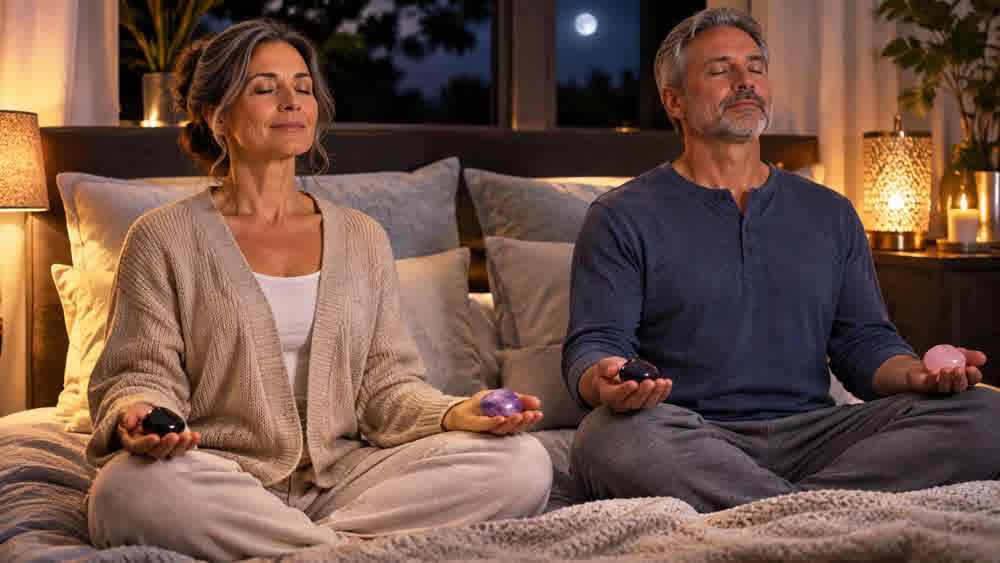
Imagine sitting comfortably in a quiet space, holding a smooth stone in each hand.
One stone represents the stress, worries or emotions you are carrying.
The other represents release, calmness and the freedom to move forward.
This gentle exercise combines breathing, visualisation and physical grounding.
If you are listening along, the next steps are paced slowly so you can practise as you go. Pause whenever you need more space.
Step 1 — Find Your Stillness
Sit comfortably, with your body supported and your feet resting on the floor if possible.
Hold one stone in each hand.
Close your eyes if that feels comfortable.
Notice the weight of the stones, their temperature and the way they rest against your palms.
Allow yourself to breathe naturally.
Step 2 — Acknowledge Your Stress
Choose one stone as your acknowledging stone.
As you breathe in gently, bring your attention towards whatever is troubling you.
Perhaps it’s a difficult conversation, a demanding day, an unfinished task or a worry about someone you love.
Imagine gathering these thoughts and emotions into the stone.
You aren’t physically drawing stress into your body. You’re simply acknowledging what you are already experiencing.
There is no need to solve anything.
Just notice it.
Step 3 — Release
Now turn your attention towards the stone in your other hand.
This is your releasing stone.
As you breathe out, imagine allowing the tension you’ve acknowledged to flow away through that stone.
Picture your worries becoming lighter.
Allow your shoulders to soften and your hands to relax.
You are giving yourself permission to put those concerns aside, even if only for a few moments.
Step 4 — Find Your Rhythm
Continue gently for a few minutes.
Breathe in: I acknowledge what I am carrying.
Breathe out: I give myself permission to let go.
There’s no need to force your breathing or make it unusually deep.
Simply allow the breath to remain comfortable.
If your thoughts wander, notice the stones in your hands and gently return your attention to the exercise.
Step 5 — Return to the Present
When you’re ready, notice the ground beneath your feet.
Feel the stones resting in your palms.
Become aware of the sounds around you.
Take one final comfortable breath and gently open your eyes.
You might feel calmer, lighter or more relaxed.
Or perhaps nothing dramatic has changed.
That’s perfectly fine.
Meditation is a practice, not a performance.
Choosing Your Stones
Different stones have different natural characteristics, histories and spiritual associations.
You may choose one because of its traditional meaning or simply because something about its appearance, shape or texture appeals to you.
Here are three beautiful examples.
Black Obsidian — Protection and Grounding
Obsidian is a naturally occurring volcanic glass formed when lava cools rapidly.
Usually deep black with a glossy, reflective surface, it is valued for its striking appearance and smooth texture when polished.
Obsidian occurs in volcanic regions around the world, including parts of Mexico, Iceland and the United States.
For believers: In modern crystal-healing traditions, black obsidian is associated with spiritual protection, grounding, emotional strength and the absorption of negative energy.
For meditation: Its smooth, solid presence in your hand can help anchor your attention when thoughts begin to wander.
Amethyst — Peace and Clarity
Amethyst is a purple variety of quartz, ranging from pale lavender to rich violet.
It is found in several parts of the world, including Brazil, Uruguay and Zambia.
Its striking colour makes it popular for jewellery, decorative pieces and meditation stones.
For believers: Amethyst is associated with tranquillity, intuition, spiritual awareness, protection and mental clarity.
For meditation: Its colour, weight and texture can provide a comforting focus during breathing exercises, quiet reflection and bedtime relaxation.
Rose Quartz — Love and Compassion
Rose quartz is a beautiful pink variety of quartz, often recognised by its soft, milky appearance.
It occurs in countries including Brazil, Madagascar and South Africa.
Its gentle colouring has made it popular in jewellery, ornamental objects and crystal collections.
For believers: Rose quartz is associated with unconditional love, forgiveness, emotional healing and compassion.
For meditation: It can serve as a symbolic reminder to approach yourself with kindness, patience and understanding.
The spiritual associations described here are traditional beliefs rather than scientifically demonstrated healing properties.
For someone who connects with these beliefs, they may form an important part of the meditation experience.
For someone who doesn’t, the stones can still be beautiful, meaningful objects that encourage attention, reflection and grounding.
A Stone to Carry with You
Perhaps one of the loveliest aspects of using stones in meditation is that they don’t have to remain in your meditation space.
You can keep one beside your bed, on your desk or in your pocket.
When life becomes overwhelming, take it into your hand.
Feel its familiar surface.
Notice its weight.
Take a gentle breath.
Remember the moment of stillness you created during meditation.
Over time, that simple physical action may become a familiar reminder to reconnect with yourself.
For believers, the stone may also represent its traditional spiritual qualities.
For others, it may simply be a beautiful object that offers a welcome moment of pause.
Neither perspective needs to diminish the other.
Finding Your Own Connection
There is no single correct stone for everyone.
You might be drawn to obsidian because of its traditional association with protection.
Perhaps amethyst appeals to your desire for tranquillity, or rose quartz reminds you to treat yourself with compassion.
Or maybe you simply discover a smooth little stone whose colour, shape and texture feel right in your hand.
What matters is the connection you develop with it and the intention you bring to your practice.
At Dunes & Dreams, we celebrate both the spiritual traditions surrounding natural stones and their practical value as companions for meditation.
Explore more in Health & Wellness, or read Your Body Is Talking. Are You Listening? for a complementary look at stress, tension and everyday body care.
Because sometimes, finding your way back to yourself begins with something as small as a stone resting in your palm.
Different beliefs. Different stones. One shared intention — finding your way back to yourself.
For general wellness enquiries:
Nicky | Hands of Wellness & Kinetic Flow
Centurion, Gauteng
WhatsApp: 076 157 2207
www.kineticflow.co.za
www.handsofwellness.co.za
Health information disclaimer: This article is for education and general wellbeing awareness. Meditation, guided relaxation and grounding exercises may support general wellbeing but do not replace professional medical or psychological care. Crystal-healing properties are spiritual beliefs, not scientifically demonstrated treatments. Anyone with persistent, unexplained, worsening or concerning symptoms should seek appropriate medical advice.
Dunes & Dreams — Health & Wellness
Choose a section, then press Play selection. Each section stops at its end.
More on meditation
Read other Health & Wellness articles, explore guided sessions with Nicky, or book online.
Connect with Nicky
💬 Message Nicky directlyYour name and question stay unpublished until reviewed. Once approved, they can be read by everyone.
Ask a public question
11 reads0 likes0 dislikes
Sign in to comment, or use Ask a public question below.